Esta es una página de archivo y se conserva como referencia. El contenido histórico está disponible solo en inglés.
The Velocity family
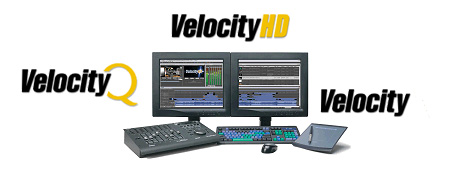
The Velocity family of non-linear editing systems, developed by Leitch (later Harris) and distributed and supported in Italy by IVS, combined quality, performance, flexibility and affordability. All models shared the same Velocity editing software, running on different hardware platforms:
| System | Hardware | Positioning |
|---|
| VelocityHD | Altitude | Format-flexible HD/SD editing: dual-stream real-time HD and multi-stream SD |
| VelocityQ | Quattrus | Advanced SD multi-stream editing with guaranteed real-time performance |
| Velocity | Reality | The most widespread and mature dual-stream SD system, running Velocity 8 (also in Italian) and expandable with ivsPowerTools2007 |
| VelocityX | None (software only) | Field and offline editing companion for VelocityHD and VelocityQ |
Leitch's hardware expertise behind these platforms won an Emmy® Award in 2000 for Outstanding Achievement in Television Technology.
VelocityHD
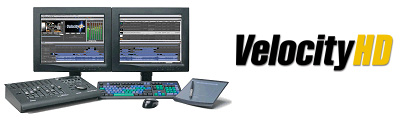
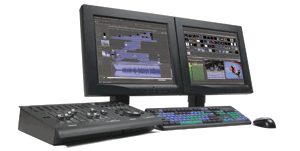
VelocityHD integrated the Altitude hardware platform with an enhanced version of the Velocity software to make HD non-linear editing as efficient as SD editing. It offered guaranteed full-quality HD playback of two video streams and two dynamic graphics streams, with optional real-time 3D DVE, on both compressed and uncompressed HD video, including HDV material mixed freely with other HD formats on the timeline. In SD it offered the highest performance of the family: eight video streams and eight graphics streams, ten of which could be layered and mixed in real time.
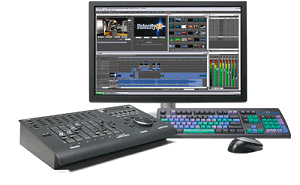
Altitude hardware
- Dual-stream real-time HD (2 video + 2 graphics streams) with real-time HD transitions and effects, all on a single card.
- Multi-stream SD: 8 video + 8 graphics streams; remaining graphics streams usable as wipe borders and DVE masks.
- Formats: 1080i, 1080PsF and 720p at all common frame rates, plus 525/625-line NTSC and PAL.
- Recording and playback in 8-bit or 10-bit uncompressed, or variable-ratio online-quality compression; compressed and uncompressed footage can be mixed in the same project.
- I/O: HD-SDI, IEEE-1394 HDV (1080i and 720p), SDI and DV for SD; VGA HD output (also YUV for analog component HD monitoring); simultaneous down-converted output for SD monitors.
- Audio: embedded SDI audio, discrete AES/EBU I/O, unbalanced analog monitoring; multi-channel mixing with flexible routing and bussing.
- Storage: optional on-board dual-channel SCSI daughtercard (SCSI-7000), or system controllers and shared storage such as SANs.
- Expansion via the Across-Card Edge eXpansion (LACEX) bus for future hardware modules.
10-bit uncompressed HD, dual-stream 8-bit uncompressed HD and full uncompressed SD required the optional SCSI-7000 daughtercard.
Main software features
- Interactive Editing: edits and real-time effects applied without stopping timeline playback.
- Integrated full-quality multi-camera editing: up to 4 HD or 8 SD cameras switched in real time, even faster than real time, with no recapture needed.
- Hundreds of keyframeable transitions and effects with spline-based Advanced Keyframer; optional A3DX 3D DVE (1 HD channel, 4 SD channels) with masks, secondary colour correction, chroma/luma keying and blur.
- Real-time HD and SD rolls and crawls; Render Bank remembers previously rendered segments.
- Real-time keyframeable colour correction: three-way colour wheels, curves, colour matching, automatic white/black re-balance.
- Trim window with 3- and 4-point edits (insert, overlay, slip, slide, fit-to-fill), three-window or two-window style; Standard, Film and Overwrite editing styles.
- EyeCon View: picons and timecode of all visible layers (and audio waveform) at the playhead.
- Panasonic VariCam variable-frame-rate processing on HD-SDI capture, including over/undercranking; batch capture and recapture, waveform monitor and vectorscope.
- Native DV25 and DVCPRO/DVCPRO50 timeline support, including Panasonic P2 MXF media; direct support for Velocity and VelocityQ projects and media.
- Output to Windows Media 9, RealVideo, QuickTime, MPEG-1 and MPEG-2 (Main Concept) directly from the timeline.
- Audio: VST plug-ins on tracks and busses with automation, DirectShow filters on clips, audio SuperNodes, on-the-fly voice-over.
- Collaboration: "Detect 'n Collect" of new media in shared folders, EDL/OMF/AAF import and export, Virtual Tape File System (VTFS) exposing frames as TGA, CIN, DPX, JPG and more.
- Bundled software: eyeon DFX+ compositing with direct timeline integration, Ulead DVD Workshop 2 SE, Inscriber TitleMotion Pro, Sony Sound Forge Audio Studio.
Options
- FAD-5000 motorized audio fader controller; JOG-5000 jog/shuttle controller.
- SCSI-7000 dual-channel SCSI daughtercard (included with some models).
- 3DM-7000 A3DX 3D DVE daughtercard.
- BOB-7000 rack-mount breakout box with built-in USB to RS-422 adapter; BOB-7002 with HD/SD SDI video bypass relay for on-air use.
- Velocity colour-coded custom keyboard.
Host system requirements (hardware/software bundle)
- Dual CPUs on a qualified motherboard, 1 GB RAM, 400 W power supply.
- One full-length 64-bit bus-mastering PCI slot (or a 32-bit slot accommodating a 64-bit board).
- At least 500 MB free on the system drive; 1280x1024 24-bit display; Windows XP Professional; Internet Explorer 5 or later.
- Dedicated system/boot drive, recommended dedicated drive for audio/graphics/projects, dedicated video storage array, DVD-ROM drive.
VelocityHD was also offered as a fully integrated turnkey system.
VelocityQ
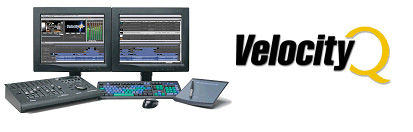
VelocityQ was the "no compromise" SD multi-stream system, combining the Quattrus hardware with the Velocity software. It played back four video streams (compressed or uncompressed), six graphics streams and up to four channels of 3D DVE simultaneously; eight of these streams could be transitioned, layered and composited in real time. It was suited to commercials, promos and "near-to-air" work, standalone or integrated with Leitch NEXIO servers.
Quattrus hardware
- Real-time playback of 4 video + 6 graphics streams; a live input could be combined as a fifth real-time stream.
- Optional Q3DX2 (two channels) and Q3DX4 (four channels) 3D DVE daughtercards.
- Mixable compressed and uncompressed video, keying, alpha channel, multi-channel audio mixing.
- Integrated Ultra160 SCSI-3 controller for up to 15 drives; SAN operation through separate controllers.
- Analog composite, Y/C and component video, balanced and unbalanced analog audio as standard; optional SDI and digital audio; DV via the host IEEE-1394 port.
- Single PCI card, single IRQ.
Main software features
- Same software interface as VelocityHD: Interactive Editing, multiple timelines, multi-clip editing, tabbed galleries, user profiles.
- Integrated multi-camera editing of up to four cameras, also live with dedicated ingest stations on a SAN (see below).
- Keyframeable transitions and effects, real-time proc amp, CPU-based colour correction with three-way wheels, curves and secondary correction.
- EyeCon View with audio EyeCons; batch capture/recapture, waveform and vectorscope.
- Native support for DV media and Panasonic P2.
- Real-time output to RealVideo, Windows Media 9, QuickTime and Ligos-powered MPEG-1/MPEG-2; live web streaming from the timeline.
- Detect 'n Collect, EDL/OMF/AAF, VTFS (TGA, BMP, TIF and more).
- Bundled: DFX+, Q-Tools standalone utilities (capture, playback, logging), Ulead DVD Workshop 2 SE, Inscriber TitleMotion, Sound Forge Studio.
Options
- FAD-5000 audio fader and JOG-5000 jog/shuttle controllers; colour-coded keyboard.
- Server Interchange Option for bi-directional push/pull of media with Leitch NEXIO servers.
- BOB-5400 rack-mount breakout box with RS-232 to RS-422 adapter; digital I/O card for SDI and digital audio.
Host system requirements
- Pentium 4 2.8 GHz or faster, or dual Xeon; 1 GB RAM; 300 W power supply.
- One full-length 64-bit bus-mastering PCI slot (or a 32-bit slot accommodating a 64-bit board), plus one for the digital I/O card.
- Windows XP Professional, 1280x1024 24-bit display, dedicated system and media drives.
- Dedicated SCSI video array: striped 10,000 rpm drives for four compressed streams (2:1 or more, up to 10 MB/s per stream); striped 15,000 rpm drives for multiple uncompressed streams.
- NTSC or PAL video monitor.
Velocity (Reality)
Velocity was the dual-stream real-time system built on the dpsReality digital disk recorder: two video streams and two dynamic graphics layers, plus real-time 3D transitions and DVEs with the V3DX module. It was the most widespread system of the family.
Key features
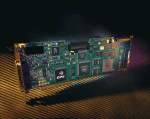
- Reality hardware: single-slot, single-IRQ PCI card with on-board ultra-wide SCSI interface.
- Real-time playback of 2 video + 2 graphics streams; compressed and uncompressed recording and playback, mixable in the same project.
- Analog composite, component and Y/C video; balanced and unbalanced stereo audio; DV via host IEEE-1394; optional SDI and digital audio cards.
- Full-frame 720x486 (NTSC) or 720x576 (PAL); dedicated preview output; adjustable genlock.
- Real-time 8-channel hardware audio mixing with parametric EQ; DirectShow audio plug-ins on the timeline.
- 200+ real-time 2D transitions (12-bit anti-aliased wipes) and, with V3DX, 200+ real-time 3D transitions, DVE (picture-in-picture, perspective, warp, rotation), chroma/luma keyer, masks and garbage mattes.
- Real-time rolls and crawls, variable speed and reverse, proc amp and colour correction, 32-bit alpha files.
- Waveform/vectorscope, batch capture/recapture and print-to-tape with RS-422 and DV control, standalone logging tool.
- Multiple timelines and galleries, EyeCon View, A/X/B or single-track modes, two-camera editing, trim window with 3/4-point edits.
- EDL import/export; OMF and AAF interoperability module; Render Bank; DPS Virtual Tape File System.
- Export to RealVideo, Windows Media, AVI, QuickTime, MPEG-1 and DVD-compliant MPEG-2; live webcasting, with remote control of a Panasonic WJ-MX20 switcher.
- Bundled: Digital Fusion DFX+ 4.0, Sonic DVDit! SE, QuickTitler, DFCG, Cayman Graphics Power CG, Sound Forge XP Studio, dpsReality application.
Part numbers
| Part number | Description |
|---|
| V2D-4030 / V2D-5030 | Velocity NLE system with real-time 2D effects (NTSC / dual standard PAL-NTSC) |
| V3D-4530 / V3D-5530 | Velocity NLE system with real-time 3D effects (NTSC / dual standard) |
| V3D-4530DX / V3D-5530DX | Velocity Deluxe with real-time 3D effects and professional AV breakout box (NTSC / dual standard) |
| SDI-4020 / SDI-5020 | SDI input/output module (NTSC / PAL-NTSC) |
| DVI-4020 / DVI-5020 | DV input/output module (NTSC / PAL-NTSC) |
| SDV-4020 / SDV-5020 | Combination SDI and DV input/output module (NTSC / PAL-NTSC) |
| 3DM-4500 / 3DM-5500 | V3DX real-time 3D effects processor module (NTSC / PAL-NTSC) |
| BOB-4000 | Professional rack-mount AV breakout box |
| 148-800200-01 | Velocity colour-coded custom keyboard |
| JOG-5000 / FAD-5000 | External jog/shuttle controller / motorized audio fader controller |
| VEL-7682UP | Upgrade to Velocity 8.1 for registered users of the full version of Velocity 7.6 with DFX+ |
| VEL-7X82UP | Upgrade to Velocity 8.1 for users of the basic (free) Velocity 7.6 or earlier |
| REL25-VEL82UP | Upgrade to Velocity 8.1 for registered users of the full dpsReality 2.5 with DFX+ |
| REL1X-VEL82UP | Upgrade to Velocity 8.1 for users of the basic (free) dpsReality 2.5 or earlier |
| DFX+, DF | Digital Fusion and DFX+ compositing, paint and effects modules |
| TMD Inscriber | Inscriber TitleMotion plug-in |
VelocityX
VelocityX brought the Velocity editing interface to a software-only NLE for laptops and workstations without dedicated video hardware, as a field and offline companion to VelocityQ and VelocityHD or as a low-cost additional editing seat.
- Flexible format and codec support: HDV, DV, MPEG-2, MXF and more, plus .dps files from VelocityQ and .ltv files from VelocityHD.
- Project compatibility with VelocityQ and VelocityHD: start on VelocityX and finish on the hardware systems, or vice versa.
- Same timeline and trim window as the hardware systems, multi-camera editing, EyeCon View, keyframeable effects and DVE, colour correction, rolls and crawls, DirectShow and VST audio plug-ins.
- EDL, OMF and AAF import and export.
Live non-linear multi-camera editing
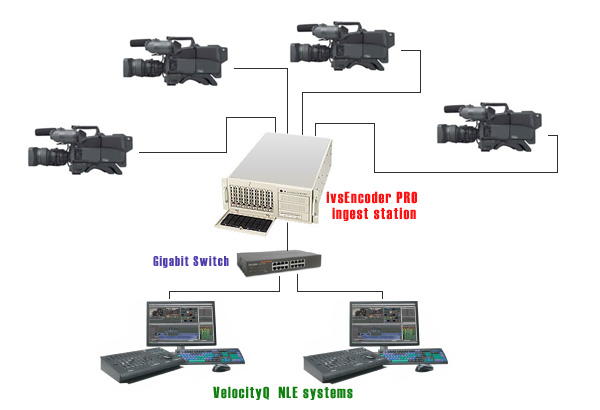
Velocity's "Live Non-Linear Multi-Camera Editing" combined integrated multi-camera editing with simultaneous recording from multiple sources: programmes could be cut interactively from the live feeds, which were also recorded separately to disk, and edit points could be refined afterwards. No recapture was needed, so the programme was immediately ready for output — the immediacy of a live switcher with the flexibility of an NLE.
Original Leitch solution (VelocityQ, 2004)
- One or more VelocityQ editing workstations, up to four ingest workstations running Leitch QIngest on Quattrus hardware, and a shared Fibre Channel SAN.
- Up to four sources switched in real time while still being recorded.
- A reference installation recorded four streams while playing back 16 (four on each of four VelocityQ systems) at 5 MB/s, plus 30 audio streams, on a Rorke Data ImageSAN with primary and backup SAN masters.
IVS "Advanced Live Non-Linear Multi-Camera Editing" (VelocityQ/HD and ivsEdits, 2009)
- Up to 8 SDI live sources captured by a dedicated ingest station running ivsEncoder Pro with four multi-I/O SDI DirectShow devices, without using the Quattrus or Altitude hardware; several ingest stations could be synchronized.
- Recording to any shared RAID storage on the LAN: no SAN required. Velocity editing systems on the same storage could start editing immediately.
- Up to 8 sources switched in real time with VelocityHD; ingest and editing could also run on a single workstation with up to 4 SDI or 3 DV/HDV inputs.
- ivsEncoder was also part of ivsNewsManager server; the Pro version allowed multiple instances (up to 8 SDI or 4 DV/HDV inputs per workstation).
- ivsPowerPack 2007 added one real-time export video stream and one real-time HQ DVE on Quattrus and Reality hardware with Velocity 7.6 or later.
- First used during the final stage of the FIFA World Cup Germany 2006 by Frame Italia S.p.A. for a pay-TV broadcaster: one ivsEncoder Pro station on a RAID 50 array of eight 15k rpm drives and two VelocityQ workstations recorded four video streams and up to 32 audio streams while playing back eight video streams, at 7 MB/s per stream. Interoperability with Nexio or SeaChange servers, XDCAM decks and P2 readers was provided by ivsBatchConverter.
For more information: info@ivs.it.
Motherboards tested by IVS
IVS tested host motherboards for each hardware platform with a DMA test (10 minutes at 25 fps = 15,000 frames; result = errors/frames). Many recent boards reached a perfect result only with IVSDMABOOST, bundled only with ivsPowerPack2007, which let Quattrus run on a 32-bit PCI slot as if on a 64-bit 66 MHz slot and removed the Reality PCI bus limitations (allowing DPS files on system or network drives; Velocity 8.x still required the P: drive for some render temp files).
| Hardware | Motherboard | Platform | DMA test result |
|---|
| Altitude | Supermicro X8SAX | Core i7, Intel X58, PCI-X | Compatible (DMA test not available for Altitude); optimal platform for advanced live multi-camera |
| Altitude | Supermicro X7DAL-E | Dual Xeon, Intel 5000X | Compatible (March 2007, driver build 99/101) |
| Altitude | Asus NCCH-DL | Dual Xeon (Nocona), Intel 875P | Compatible (October 2006, driver build 70) |
| Quattrus | Asus P6TD Deluxe, P6T Deluxe, P6T Deluxe V2 | Core i7, Intel X58 | 17-23 errors without, 0 with IVSDMABOOST |
| Quattrus | Supermicro X7DAL-E | Dual Xeon, Intel 5000X | 13-333 errors without (depending on BIOS), 0 with IVSDMABOOST |
| Quattrus | Asus NCCH-DL | Dual Xeon, Intel 875P | 0 (perfect) |
| Quattrus | Supermicro X6DA8-G2 | Dual Xeon, Intel 7525 | 13689 errors without, 0 with IVSDMABOOST |
| Quattrus | MSI 6501 | Dual Athlon MP, AMD 762MP | 0 with IVSDMABOOST |
| Quattrus | Asus P4C800-E Deluxe | Pentium 4, Intel 875P | 0 (perfect) |
| Reality | Asus P6TD Deluxe, P6T Deluxe, P6T Deluxe V2 | Core i7, Intel X58 | about 1,000-1,100 errors without, 0 with IVSDMABOOST; the best boards for Reality |
| Reality | Asus P5Q Pro, P5K, P5B-E Plus, P5B-E | Core 2, Intel P45/P35/P965 | 6,670-11,723 errors without, 0 with IVSDMABOOST |
| Reality | Supermicro X7DAL-E | Dual Xeon, Intel 5000X | 14,788 errors without, 0 with IVSDMABOOST |
| Reality | Asus P5PE-VM, P5P800 SE, P4P800-E, P4C800, P4C800-E Deluxe | Pentium D / Pentium 4, Intel 865/875 | 0 (perfect) |
Typical tested configurations used an NVIDIA graphics card, a dedicated boot disk with four partitions, a separate video disk or array, on-board audio disabled, and optional Blackmagic DeckLink and IEEE-1394 cards. Some recent boards had no rear RS-232 port, so a USB to RS-422 cable or an RS-232 card was needed for VTR control. Charts were last updated between June 2007 (Altitude) and November 2008 (Quattrus and Reality).
Altitude, Quattrus, Reality, Velocity, VelocityHD, VelocityQ and VelocityX are trademarks of Harris Corporation.